
Are you searching for ways to fix persistent echo and uneven sound in your meeting room? If buzzing reflections (“flutter echo”) or loud “hot spots” (“sound focusing”) are disrupting your meeting room acoustics, you’ve identified two of the most common culprits. This professional guide cuts through the noise, explaining the science behind these issues and providing clear, actionable acoustic solutions to transform your space. No more straining to hear—achieve the clarity needed for productive and professional meetings.
Ⅰ. Problem Analysis:
Imagine the hard, parallel surfaces of your meeting room—opposite walls or the ceiling and floor—acting as giant ping-pong paddles. Sound waves (particularly mid-to-high frequencies) bounce rapidly between them. With sufficient distance, these reflections can occur dozens of times per second, merging into a lingering “buzz” or “flutter.” This acts like a “frosted glass” filter over speech, drastically reducing clarity and forcing listeners to strain, which leads to rapid fatigue.
Ⅱ. Professional Solutions:
1) Install Sound-Absorbing “Buffer Pads” (Primary Strategy):
Objective: Apply high-performance acoustic materials to key parallel surfaces to absorb excess sound energy, stopping the “ping-pong” effect at its source.
Implementation: Install polyester fibre acoustic panels, mineral wool boards, or high-quality fabric wall panels on side walls and/or ceilings. These materials act as acoustic “sponges,” capturing sound energy and significantly reducing reverberation time.
Material Selection: Prioritize materials with a high NRC (Noise Reduction Coefficient) rating—typically NRC > 0.8 for effective absorption. These solutions can be seamlessly integrated into the interior design.
2) Disrupt the Sound Reflection Path (Secondary/Combined Strategy):
Objective: Break up strong, coherent reflections by scattering sound energy in multiple directions.
Implementation: Install acoustic diffusers on strategic wall sections. Featuring designed surface irregularities, diffusers scatter sound waves, preventing them from forming a steady flutter echo. This preserves acoustic liveliness in the room, avoiding the over-damped feeling that can result from excessive absorption alone.
Ⅰ. Problem Analysis:
Some meeting rooms feature curved designs like domed ceilings, barrel-vaulted walls, or large concave surfaces for aesthetic appeal. Acoustically, these concave shapes act like focusing lenses, concentrating reflected sound waves into specific “hot spots.” This creates severe imbalance: sound pressure becomes intolerably high at the focal point, while areas outside it remain poorly audible, fracturing the shared listening experience.
Ⅱ. Professional Solutions:
1) Alter the Surface Geometry (Definitive Remedy):
Objective: Replace sound-focusing concave shapes with sound-scattering convex or flat surfaces.
Implementation: During construction or renovation, redesign concave domes into convex (curved-out) shapes or flat ceilings. A convex structure acts like an umbrella, dispersing sound energy broadly to prevent focusing.
2) Install Sound Diffusers (Effective Retrofit Solution):
Objective: Break up concentrated sound energy in existing problematic architecture.
Implementation: Mount specially designed diffusers, such as Quadratic Residue Diffusers (QRD) or Maximum-Length Sequence diffusers (MLS), onto problematic concave surfaces. These engineered devices effectively scatter focused sound, promoting even distribution. Modern diffusers also serve as sophisticated architectural elements.
Excellent room acoustics result from a balanced integration of absorption, diffusion, and sound isolation.
1) Diagnose First: Identify the primary issue—is it flutter echo, focusing, or general excessive reverberation? A professional acoustic assessment or a simple “clap test” can provide initial insights.
2) Balance ‘Absorb’ and ‘Diffuse’: Avoid a single-method approach. A common strategy is to use absorption on primary reflection points (side walls, ceiling) to control echoes and reverb, complemented by diffusion on rear walls or specific surfaces to maintain sound field uniformity and naturalness.
3) Consider Holistic Elements: Do not overlook the acoustic contribution of soft furnishings like carpets, heavy curtains, and upholstered seating, which offer cost-effective sound dampening.
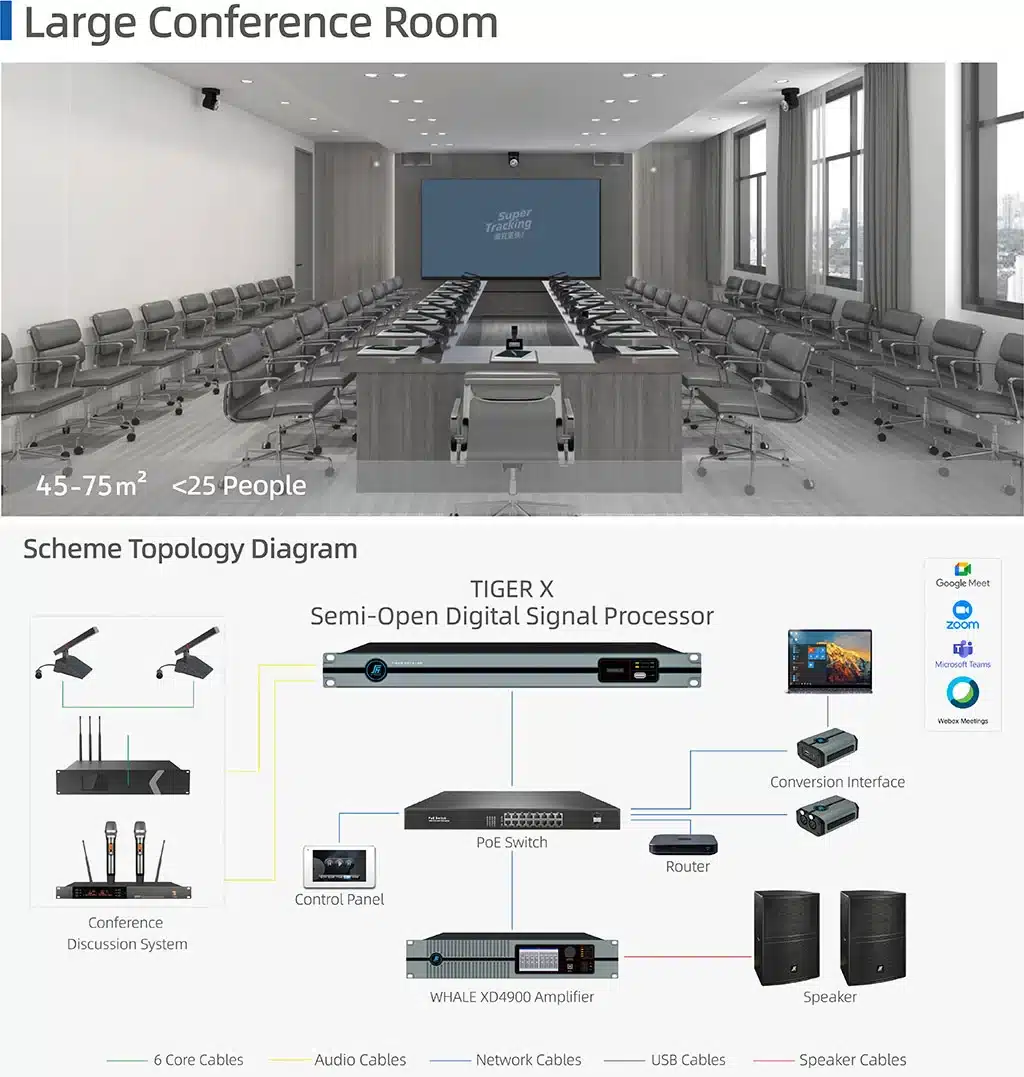
A meeting room’s core function is to facilitate clear communication. Investing in professional acoustic optimization is an investment in your team’s efficiency, decision-making quality, and comfort. Eliminating disruptive echoes and sound focusing ensures every seat is a “sweet spot” for listening and contribution, allowing clear communication to become a seamless part of your professional culture.
S-Track looks forward to creating a similarly clear and productive acoustic environment for you.
Contact us for a customized acoustic design solution.
400-900-2726
9th Floor, 1B, Shangzhi Technology Park, Guangming District, Shenzhen City, Guangdong Province, China
Copyright © SHENZHEN S TRACK SCIENCE TECHNOLOGY CO., LTD