

In audio system design and subjective listening evaluation, frequency response and frequency range are two fundamental parameters that determine a system’s sound reproduction capability. Together, they define the amplitude-frequency behavior of audio equipment, directly influencing sound fidelity, tonal balance, and suitability for various applications. This article explains their acoustic principles, from definition and measurement to perceptual impact and practical application, and discusses their relationship with dynamic range.
Frequency response describes the variation in output sound pressure level as a function of frequency under steady-state conditions, typically represented as an amplitude-frequency curve. In specifications, it is commonly expressed as “20 Hz – 20 kHz ±3 dB,” meaning the output level stays within ±3 dB of a reference value across that range. A flatter response indicates more accurate sound reproduction.
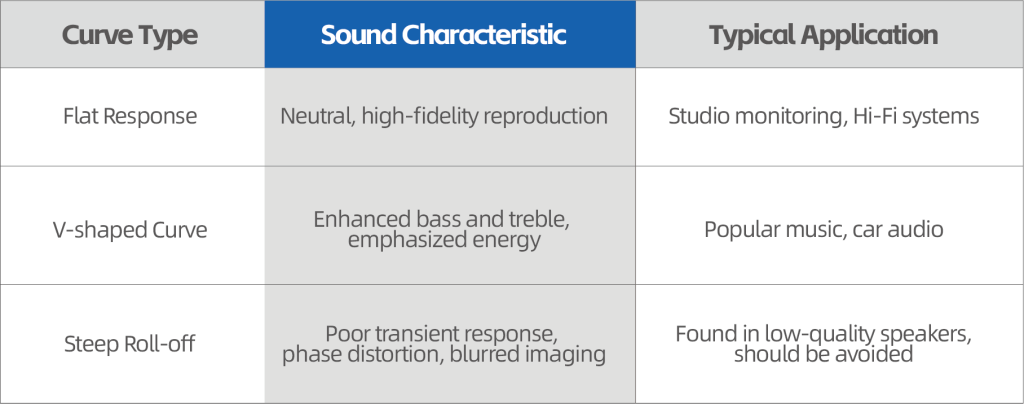
Note: Roll-off Slope
The roll-off slope (e.g., 12 dB/octave) indicates how quickly output declines outside the passband. Gentle slopes preserve phase coherence and detail; steep slopes (>24 dB/octave) may cause phase distortion and impair sound localization.
The human ear can theoretically perceive 20 Hz – 20 kHz, though adults often hear only up to 15 kHz. A high-quality sound system should cover a broad range to faithfully reproduce diverse program material:
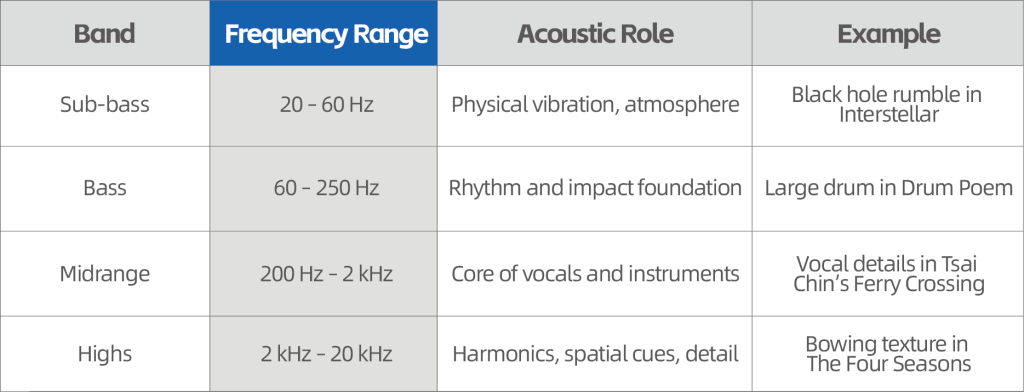
Full-range balance:
Wide frequency range alone does not guarantee fidelity. A pronounced boost in the low end (e.g., +6 dB) can muddy kick drums and weaken definition. Standards such as THX recommend delegating frequencies below 80 Hz to a dedicated subwoofer, with main speakers handling 80 Hz – 20 kHz for optimal phase alignment and clarity.
Dynamic range (DR) is the ratio between the maximum undistorted output and the noise floor: DR = 20log10(Pmax/Pnoise) (Unit: dB)
Frequency response and frequency range form the physical basis of sound system performance, directly shaping realism and emotional impact. In system design and tuning, these parameters should be evaluated through both objective measurement and subjective listening, tailored to the content and environment, to achieve a harmonious balance between technical precision and auditory experience.